
The Abstract Realm of the Painter Hồng Đức
“I paint abstraction for myself… painting is a need, like eating and breathing every day.” An early-spring meeting with the painter Trần Hồng Đức.
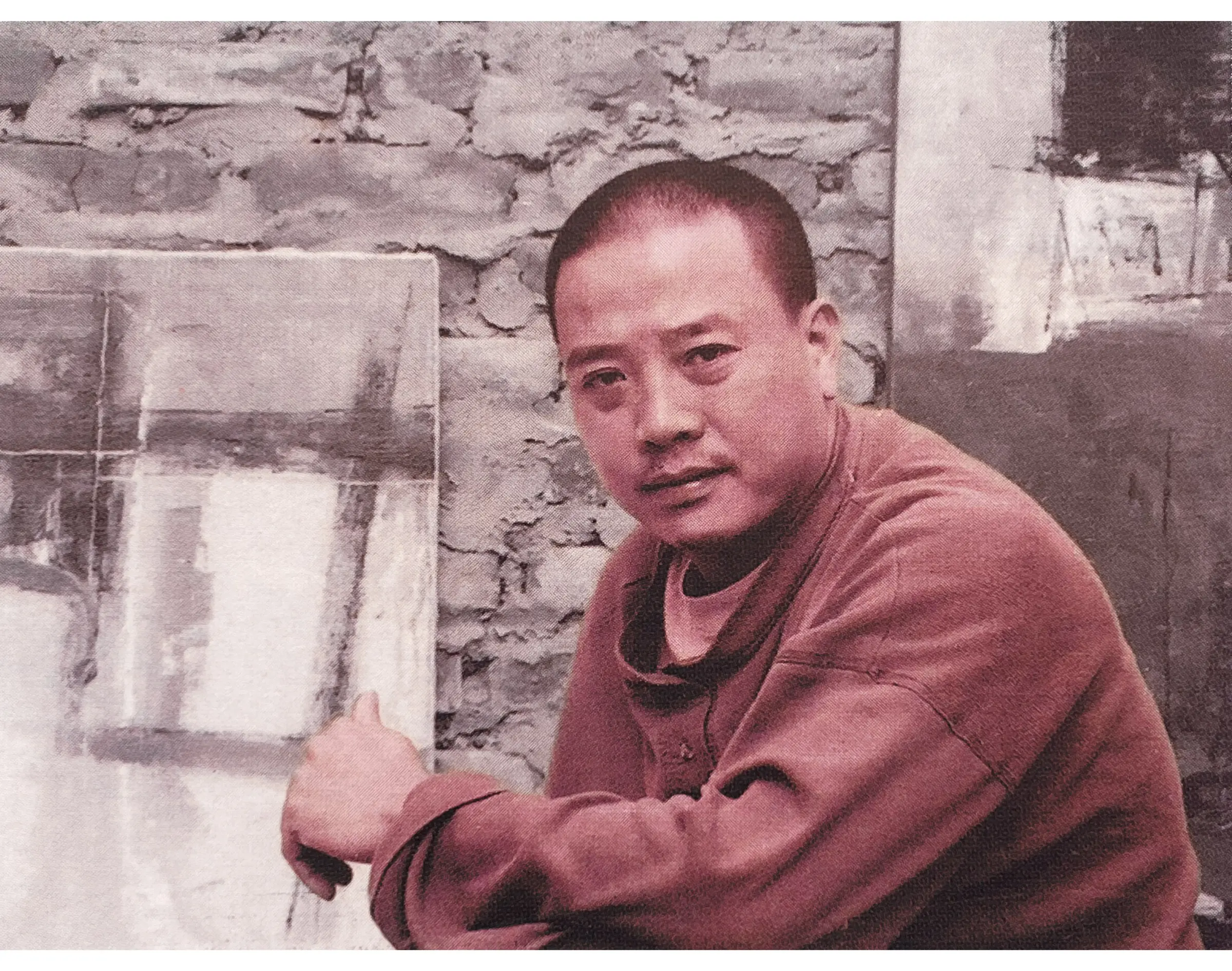
Art and the world of painting are as vast as the universe out there. Within it, every artist and every work is a boundless small universe of its own. To meet, understand or own a work takes a great deal of fate. And that is only when we consider what is tangible — so what about abstract art? Can we hold on to a dream?
The Western view of abstract art
Abstract art (abstractionisme) emerged in America and Europe in the late 19th and early 20th centuries, alongside many other movements (Impressionism, Surrealism, Cubism, Expressionism…). It set out to escape the constraints of form, to reach a freedom of expressing ideas and to liberate the artist’s thought. In studies of how the brain thinks, too, Abstract Thinking is the stage of reflecting things indirectly and in general terms, through forms such as concepts, judgements and reasoning.
Abstraction and emptiness in Asian culture
In the Yellow River basin, the cradle of North Asian culture, people very early on reached a generalised, abstracted understanding of the world, which gave rise to pictographic writing on tortoise shells (oracle bone script). Today at least one fifth of humanity still uses it every day: it is the writing of modern Chinese. It could be seen as one of the oldest forms of abstract painting in the world.
Another dimension comes from Buddhism, especially Zen. Emptiness (vô) is an abstract concept: it contains everything and at the same time nothing. To say that Emptiness is nothing is wrong, yet to say what that Emptiness contains is not right either. The enlightened who grasp the beauty of this abstract Emptiness all agree that its wondrous nature is always present within each of us; what is needed is understanding, so that this marvellous world can blossom and shine.
In truth, reading these definitions, I (the writer) could not explain in the end what abstract art or abstract thought really is (!). But perhaps the very moment we try to explain or pin down “the abstract”, would that vast Abstract-Realm not vanish at once into nothingness? And how, and on what basis, can we understand the works of the painter Hồng Đức?
The abstract realm of the painter Hồng Đức
The painter Hồng Đức, full name Trần Hồng Đức, was born in 1960, the year of the Metal Rat. Old books say, “Men born in this year meet no small hardships and trials in life, but in return their careers hold great and bright promise. Later come ease and happiness.” The painter I met on an early spring day seemed to be exactly that. To reach the ease, warmth and good cheer he has today, I could see he had been through many hardships and upheavals — the kind that, when one day they let us smile at peace with ourselves, are not easy to come by. He admits it himself: “Truly, there were many times it wasn’t easy to get through, but so what — that’s life; what matters is to be happy.”
At 61, Hồng Đức has been devoted to abstract art for more than 25 years. Twenty-five years of painting without a break, bound to a vague abstraction that even “insiders” sometimes misjudge. He says: “I paint abstraction for myself. If I think or analyse too much, where is the joy in painting? Painting is a need, like eating and breathing every day — on the days I can’t pick up a brush, I feel restless and ill at ease!” So do the motifs in his paintings come from something specific before he paints — a forest, a field, a garden, the cosmos or the sea? I asked. “It could be all of them, or nothing in particular, because once I hold the brush, everything flows onto the canvas one thing after another; my job is simply to let it come out naturally.” But you know, painting is not easy by nature: for the brush to keep flowing, the forms to keep appearing and the painting to turn out good and beautiful, mind and body must be one and the technique must be forged through hard work — and even then, only with luck.
I find that the most precious thing in an artist’s whole life in art is naturalness — and the naturalness in a painting comes only after the ego has wanted to give up and surrender many times over. Fortunately, Hồng Đức seems to have reached that vast abstract realm: a place where every definition, every rule, every notion of right and wrong, every concrete shape — all the joy, anger, love and hate of life — is sublimated, dissolved and made one in each stroke of his colour. That is the abstract realm of Hồng Đức’s painting: everything, and at the same time nothing at all!
The abstract realm of Hồng Đức is, in the end, his own world. Each work is like a small window that lets us “see” a little of the artist’s mind — a place where the simplest thoughts and ideas take shape. To “see clearly” these simple things that verge on abstraction, we cannot use the reality before our eyes as the measure; what we need is the guidance of the clear heart of the painter Hồng Đức.
Are we, perhaps, living in an abstract dimension?
That is entirely possible, for from the Buddha to Albert Einstein, all have held that everything in this world is relative. What if one day our eyes could see 360 degrees, as a dragonfly does? Curved would no longer be curved, straight would no longer be straight; circles, squares, triangles, colours and so on would all have to be defined anew. How difficult it would be if everything changed like that! But, my friend, let your mind fly free and gaze at the wonderful world of colour and thought in the fascinating abstract works of Hồng Đức — and who knows, you may discover so many wonderful things about yourself.
Khúc Ngọc Minh · Hà Nội, March 2021 — translated from Vietnamese · First published in Tạp chí Mỹ thuật (Fine Arts Magazine)